Aaron Douglas Art Aspects of Negro Life From Slavery Through Reconstruction Date
1 of the greatest cultural phenomena of the interwar flow in the United Land was undoubtedly the Harlem Renaissance. Information technology has appeared in the aftermath of the offset wave of the Not bad Migration, when thousands of African Americans left the Southern parts of the confederation and populated the Northward to reach social and economic stability and dignified existence.
The streets of the New York district called Harlem became a site of ongoing shifts and a climate that enabled artists, writers, scientists, and other Black Americans to articulate their own culture and racial pride. The Negro movement, as the Harlem Renaissance was called at the time, nurtured numerous highly talented women and men who embraced modernity to the total extent while exploring and celebrating their racial heritage, too as their position in arts that were overshadowed by the white privilege.
I of the leading artists of this movement was Aaron Douglas, a painter highly acknowledged for his amazing visual language based on the intersection of modernist aesthetic and African traditional fine art. His contribution to representing Blackness histories and experiences is grand and is perhaps best shown in his panel serial of four murals titled Aspects of Negro Life: From Slavery to Reconstruction .
Now, before we come to the characteristics and the interpretation of the aforementioned, it is mandatory to revisit Douglas's artistic domains and his pathway saturated with the social engagement that was very much unprecedented at the time.
Aaron Douglas, Male parent of Afro-Centric Modernism
Aaron Douglas (1899 – 1979) was a distinct painter, illustrator, and visual arts educator who gained recognition for his distinguished, socially charged murals and illustrations centered on Afro-centric imagery. Afterwards high school, aslope working numerous jobs to support himself, he took free classes at the Detroit Museum of Art before studying college at the University of Nebraska where he received a Bachelor of Fine Arts caste in 1922. For a twelvemonth, the artist worked as a waiter and then a educational activity position appeared at Lincoln High School in Kansas City, Missouri, where he stayed until 1925.
Burning from a desire to fully commit himself to art, Douglas decided to travel to Paris, and on his way there he stopped in Harlem, at the very superlative of the Harlem Renaissance. Influenced past the writings of Alain Locke, and the teachings of a German portraitist Winold Reiss, the creative person felt empowered to focus on Afro-centric themes. During this fourth dimension, he served every bit a contributor to diverse magazines, and in 1927 Douglas produced i of his get-go murals at Club Ebony, the central spot of Harlem nightlife. Several scholarships occurred, besides as other landscape commissions, and the artist acted as president of the Harlem Artists Gild in 1935. In the 1940s, Douglas took the teaching post at Fisk Academy in Nashville, Tennessee, while attending Columbia Academy Teacher's Higher in New York City. He retired from pedagogy in 1966 and died at the age of 79 in 1979.
Although Aaron Douglas is all-time known as a muralist and illustrator, he was also a notable portraitist. In general, his aesthetic is described as abstract, but non entirely deprived of figuration. His two-dimensional compositions inhabited by faceless silhouettes of man figures generate the symbolic potential of modernity nether which the marginalized felt liberated to express themselves regardless of the social canons. By matching the West African masks and sculptures imagery with a painterly technique reminiscent of Cubism, Douglas managed to construct a powerful social commentary, while existence among the start ones to use visual arts as a vehicle for the outspoken articulation of racial problems and segregation in the United States.
Aspects of Negro Life
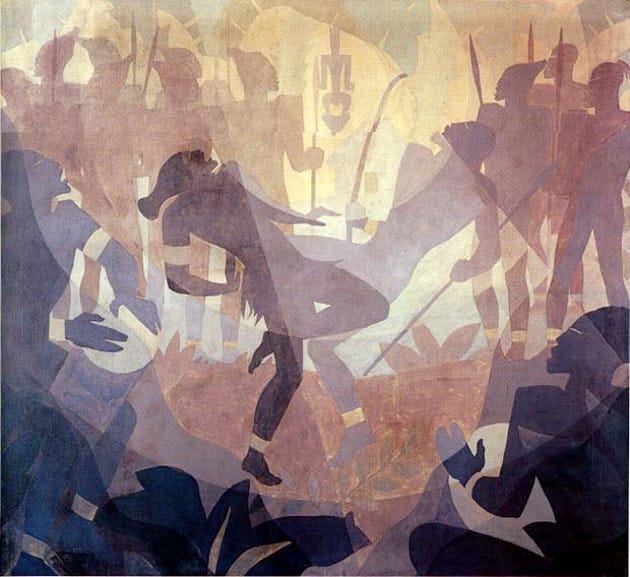
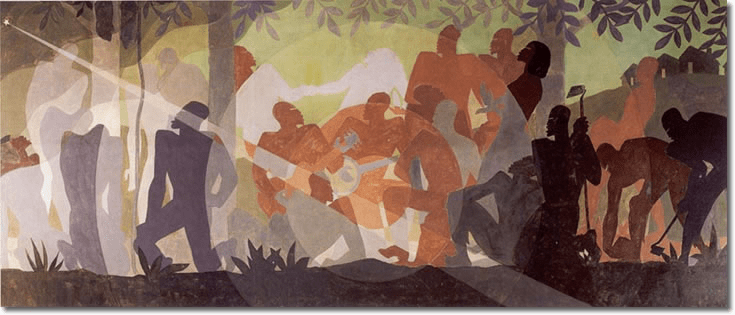
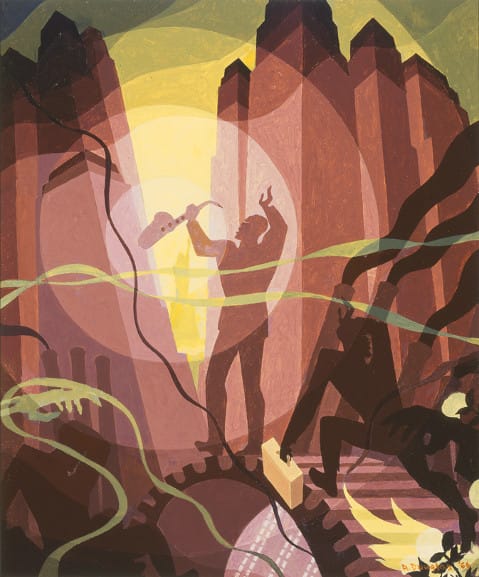
The four murals, role of the series Aspects of Negro Life, were produced past Douglas in 1934. The works visually trace the emergence of Black America, starting from their African homeland, to their histories in slavery, the emancipation, and the reemergence of African traditions. Aside from the fact all the murals are equally important for the understanding of the artist's vision, it seems that the second console entitled From Slavery to Reconstruction is most striking equally it encapsulates Douglas' style and the mode this painting impacted the entire New Negro motility.
All the same, we volition start from the beginning mural, The Negro in an African Setting that features bewildered silhouettes in their African homeland; the mentioned, second one features the silhouettes expressing the doubt of African American slaves among the reading of the Emancipation Proclamation of 1863. The third mural called Song of the Towers captures the boldness and strength of the Blackness leaders at the fourth dimension. The effigy holding a document stands in the middle while pointing to the Capitol, and empowering the Blacks to gratuitous themselves. The final landscape An Idyll of the Deep South depicts the withdrawal of the Union soldiers from the South and the rise of white supremacist groups, well-nigh notably the Ku Klux Klan.
The country, the sun, the foliage, and human beings that are nowadays on each mural from the Aspects of Negro Life series are omnipresent natural elements present throughout most of Douglas' artwork. For instance, in this detail series, he used the concentric circles to highlight important documents; the cotton-growing from the state underlines the element of foliage that takes a prominent role in African American slavery.
The Significance of The Slap-up Mural Series
After Douglas showed the mural for the first time, he was exposed to severe criticism as the glorification of African heritage during the Harlem Renaissance was perceived as an declared portrayal of blacks every bit inferior to whites. Co-ordinate to some, this kind of representation omitted or rather negated the emancipation of African Americans equally it coincided with the misconception of what was considered civil and what was considered primitive at the fourth dimension (nonetheless another white supremacists stereotype that came from the colonial era).
Before the Harlem Renaissance, there was basically no artists inspired by the traditional African artwork. Notwithstanding, Douglas decided to move away from the typical European arroyo and embrace something novel and like shooting fish in a barrel to connect with. Despite the fact his work was discarded and seen as grotesque during the New Negro Movement, Aspects of Negro Life succeeded in underlining the urgency for African American identity.
Finally, throughout his years as an creative person and educator, Douglas managed to alter the way other artists viewed African Americans. As a prominent president of several activist organizations that supported thousands of artists, and the start Black American artist who consciously worked with African imagery, he left an enormous legacy particularly with this landscape that still inspires many in the current moment marked past racism and urgency of political struggle for racial equality.


In paintings, murals, and book illustrations, Aaron Douglas (1899–1979) produced the most powerful visual legacy of the Harlem Renaissance, prompting the philosopher and author Alain Locke to dub him the "father of Black American art." Working from a politicized concept of personal identity and a utopian vision of the future, the artist made a lasting touch on on American art history and on the nation'south cultural heritage. Douglas's function, as well as that of the Harlem Renaissance in general, in the development of American modernism deserves shut scholarly attention, which it finally receives in this beautifully illustrated volume.
Featured epitome: Aaron Douglas - Aspects of Negro Life: From Slavery to Reconstruction, 1934. © Aaron Douglas. Image courtesy New York Public Library.
meltonhiculoveirs.blogspot.com
Source: https://www.widewalls.ch/magazine/aaron-douglas-aspects-of-negro-life
0 Response to "Aaron Douglas Art Aspects of Negro Life From Slavery Through Reconstruction Date"
Post a Comment